Last updated: October 22, 2026
Guitar Intervals: Shapes for Major, Minor and 7th Chords
Have you ever struggled to memorize chords?
These shapes connect the most common chord qualities and voicings.
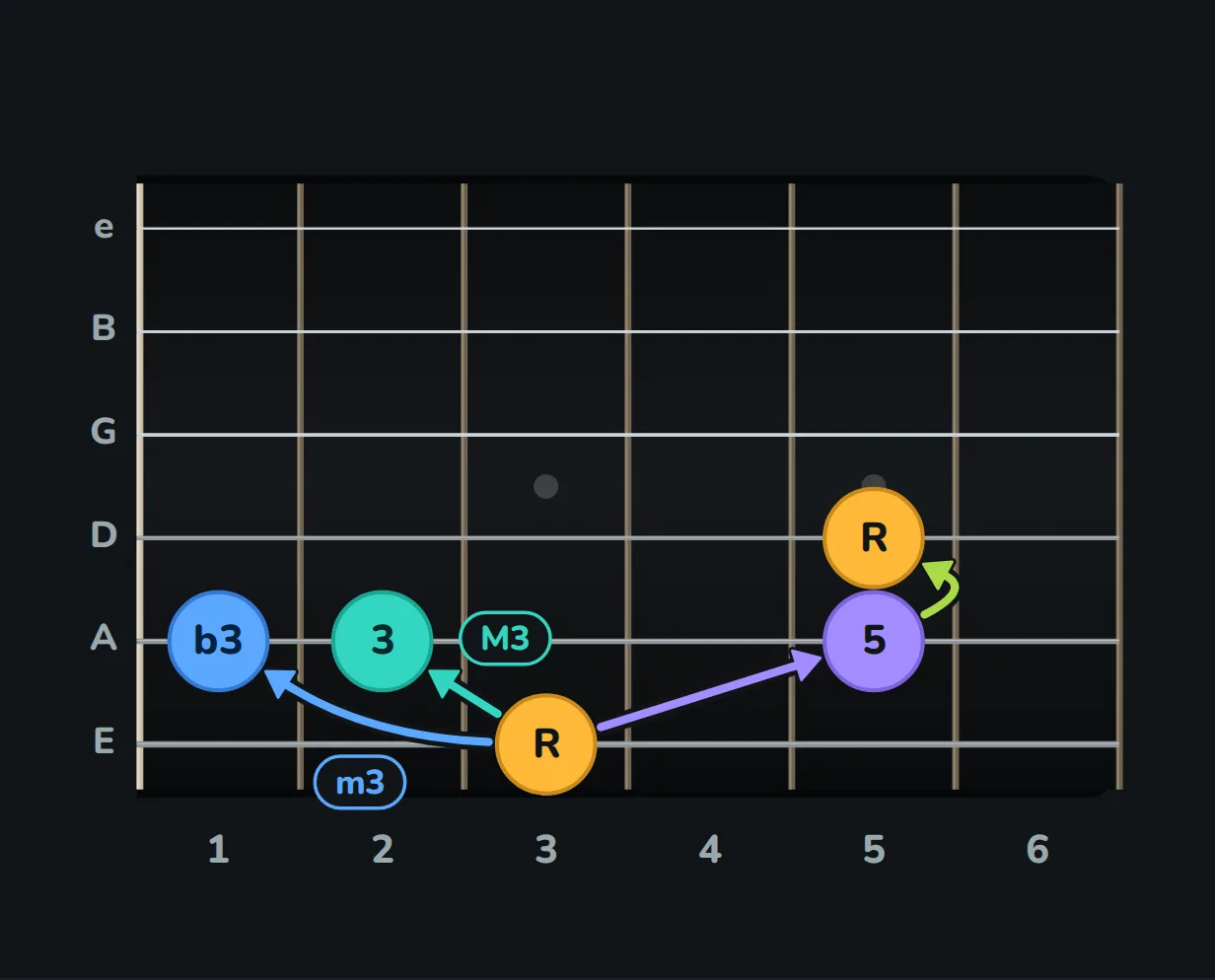
From a root: the major-third and minor-third shapes, the root-to-five shape, and the five-to-root shape.
Once you learn to use them, you will start seeing them everywhere and be able to build chords yourself.
What chords are made of: stacked thirds
Almost every chord you know is built from stacked thirds.
Take C major, one of the first chords most of us learn. It has five notes, but only three different ones: C, E and G.
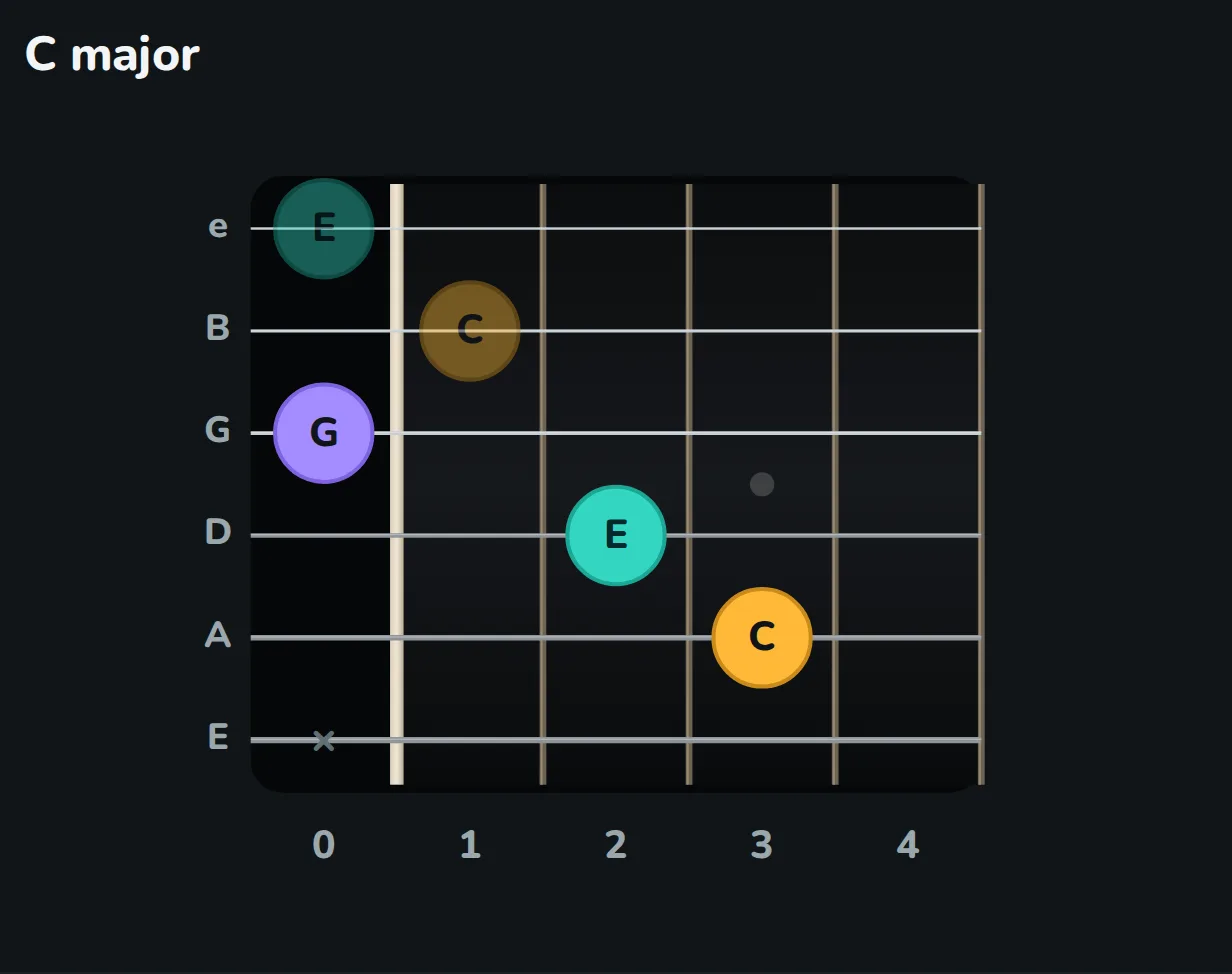
The repeated C and E are dimmed: only C, E and G are different.
Enable JavaScript to hear these notes.
Let’s put those three on a single string. From C to E is four frets. From E to G is three frets.
Scroll sideways to inspect every fret.
Static diagrams are shown below. Enable JavaScript to play this demonstration with guitar sound.
Inspect the final diagram
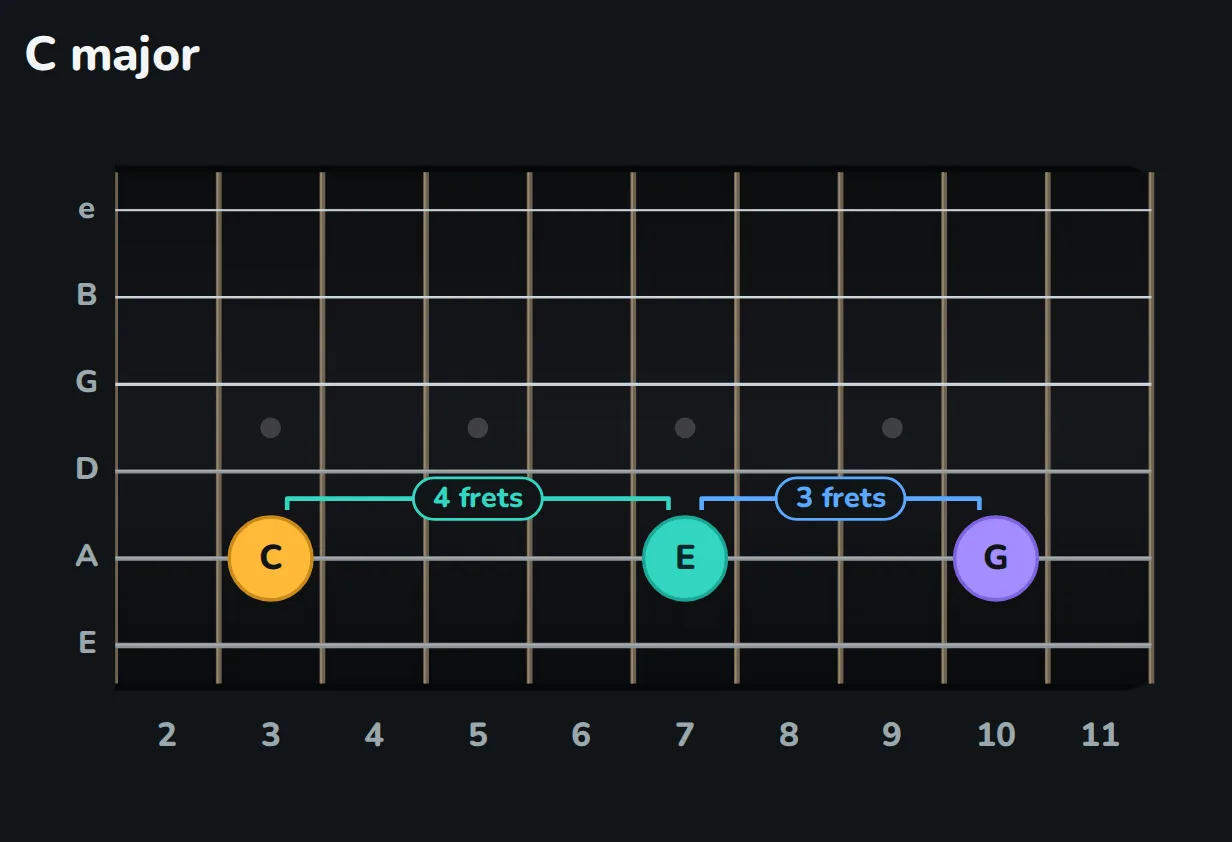
From E to G: three frets
Those distances are called intervals, and these two are both thirds. They’re called thirds because each one spans three letter names: C, D, E, and E, F, G.
Four frets is a major third. Three frets is a minor third.
Stacking means starting on one note, adding a third above it, then another third above that one, and so on.
C, a major third up to E, then a minor third up to G: that’s C major.
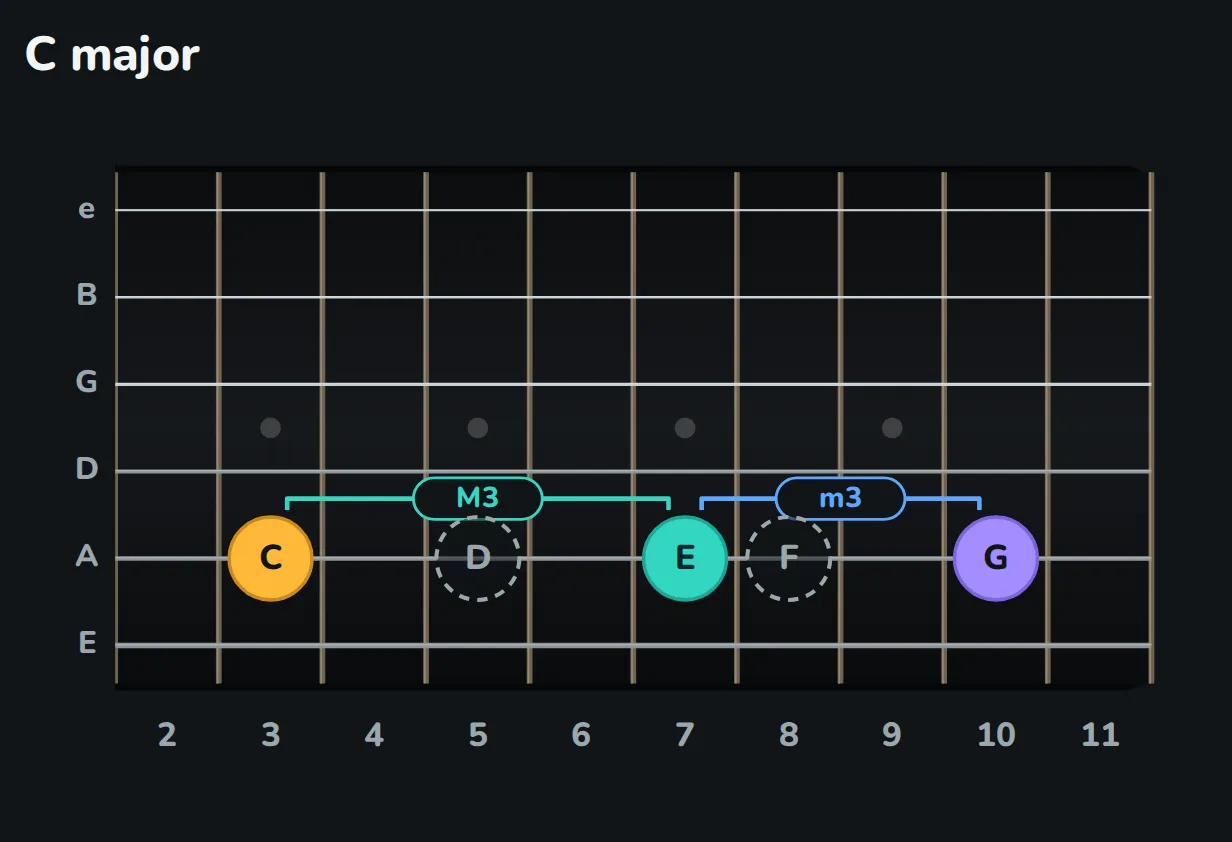
Scroll sideways to inspect every fret.
C to E spans C, D, E: four frets, a major third. E to G spans E, F, G: three frets, a minor third.
Enable JavaScript to hear these notes.
These are the chord tones. C, the note the chord is built from, is the root. The others are numbered by counting letter names up from the root, with the root as one: C one, D two, E three, F four, G five. So E is the three, and G is the five.
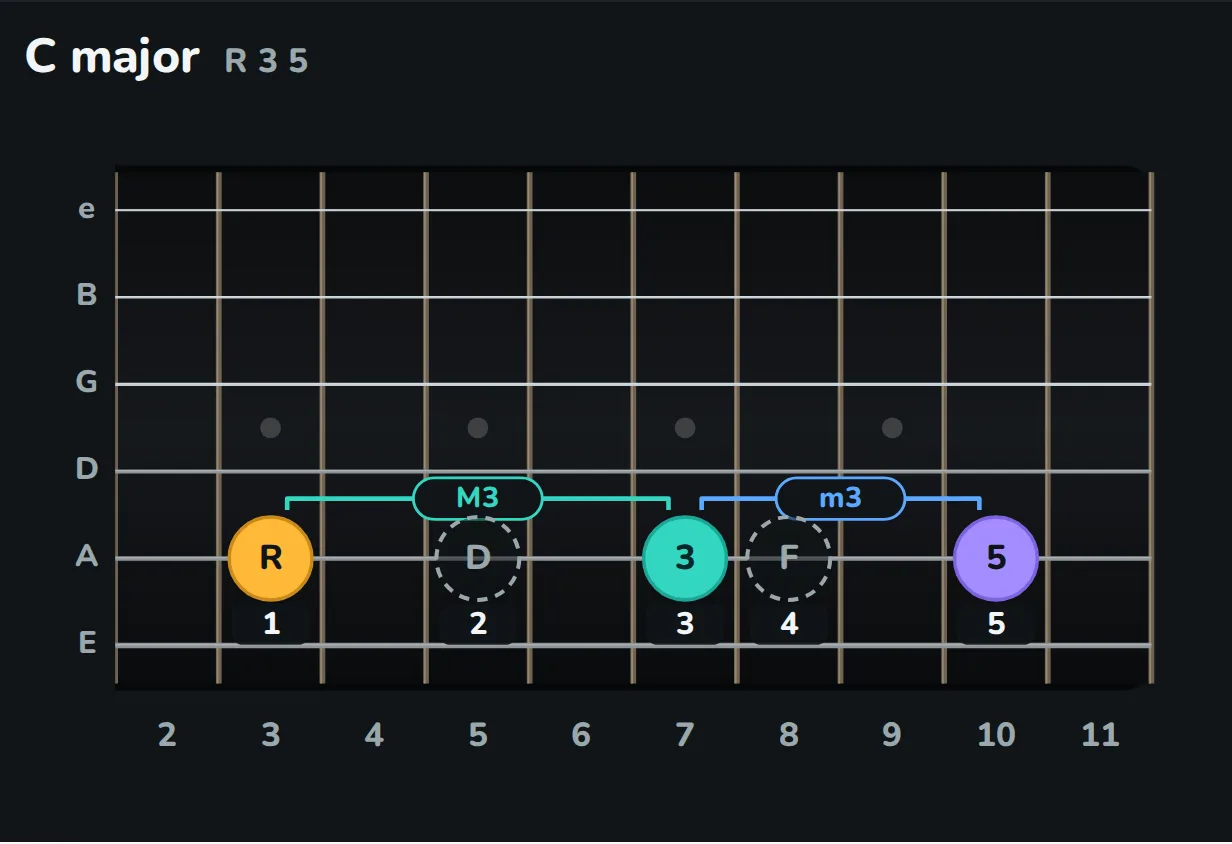
Scroll sideways to inspect every fret.
Counting letter names up from C, with C as one: E is the three and G is the five.
Enable JavaScript to hear these notes.
Five chord qualities from two thirds
Let’s see this rule applied to build five different chord qualities and compare them to each other.
The major chord is the one we just built: a major third, then a minor third.
The minor chord reverses the order. First a minor third, which lands one fret below the three. That’s the flat three: flat means one fret lower. Then a major third. We still land on the same chord tone, the five.
We can keep stacking: a minor or a major third above the five.
Starting with the major chord, we add a major third above the five to get a major seven chord.
If instead we add a minor third above the five of the major chord, we land on the flat seven, one fret below the seven. This chord is called a seven chord, or dominant seven.
If we start with the minor chord and stack a minor third on the five, we get a chord with both flat three and flat seven, called a minor seven chord.
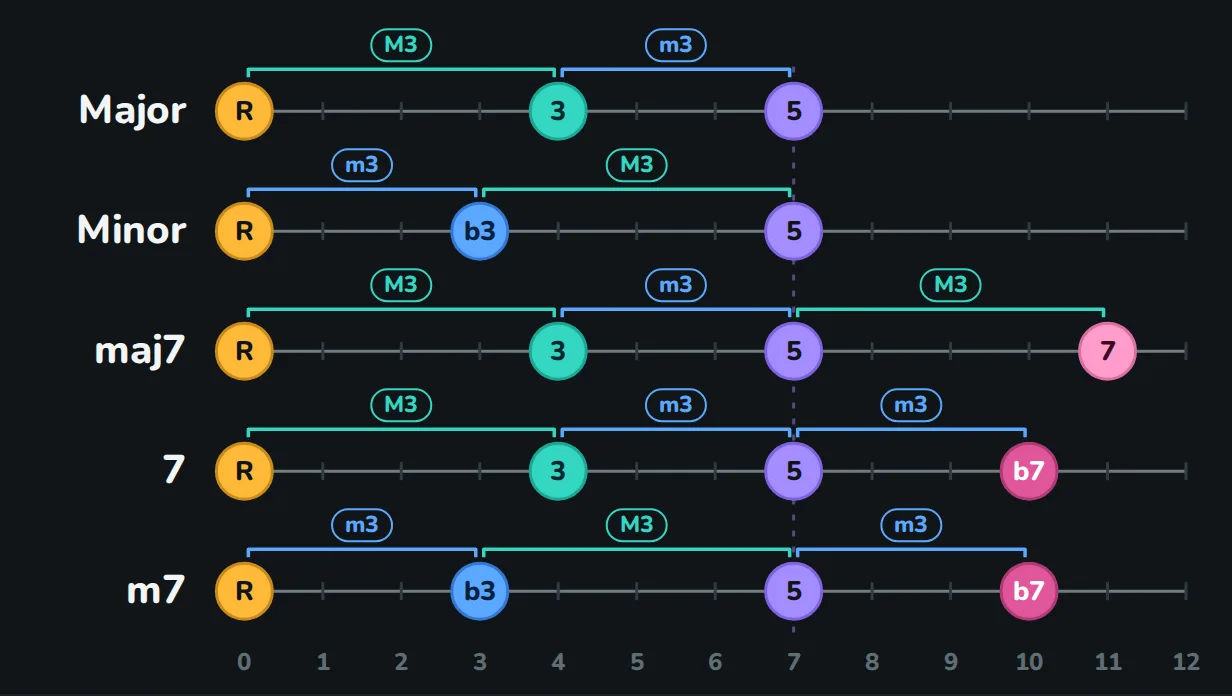
Each row stacks thirds on one string from C. The dashed line marks the five, the same in every row.
Enable JavaScript to hear these chords.
Major and minor have three chord tones, and they are called triads. They differ only in the order of the thirds; both land on the same five.
The seventh chords stack one more third, and that third decides seven or flat seven.
So for these chords we are learning, the five never changes. Only the third, three or flat three, and the seventh, seven or flat seven.
| Chord | Thirds, from the root | Chord tones | On C |
|---|---|---|---|
| Major | major, minor | R 3 5 | C E G |
| Minor (m) | minor, major | R ♭3 5 | C E♭ G |
| Major seven (maj7) | major, minor, major | R 3 5 7 | C E G B |
| Seven (7), dominant seven | major, minor, minor | R 3 5 ♭7 | C E G B♭ |
| Minor seven (m7) | minor, major, minor | R ♭3 5 ♭7 | C E♭ G B♭ |
The major-third and minor-third shapes
Now let’s take this across the strings, starting on B, seventh fret of the low E string.
On one string, a major third is four frets. But the same chord tone also sits on the next string up, one fret lower. That’s the major-third shape.
A minor third is three frets on one string, or the next string up, two frets lower. That’s the minor-third shape.
These are two of the shapes you saw at the start. They’re the same intervals, so they work just like on one string: put one on top of any chord tone, and it reveals the next.
Scroll sideways to inspect every fret.
Static diagrams are shown below. Enable JavaScript to play this demonstration with guitar sound.
Inspect the final diagram
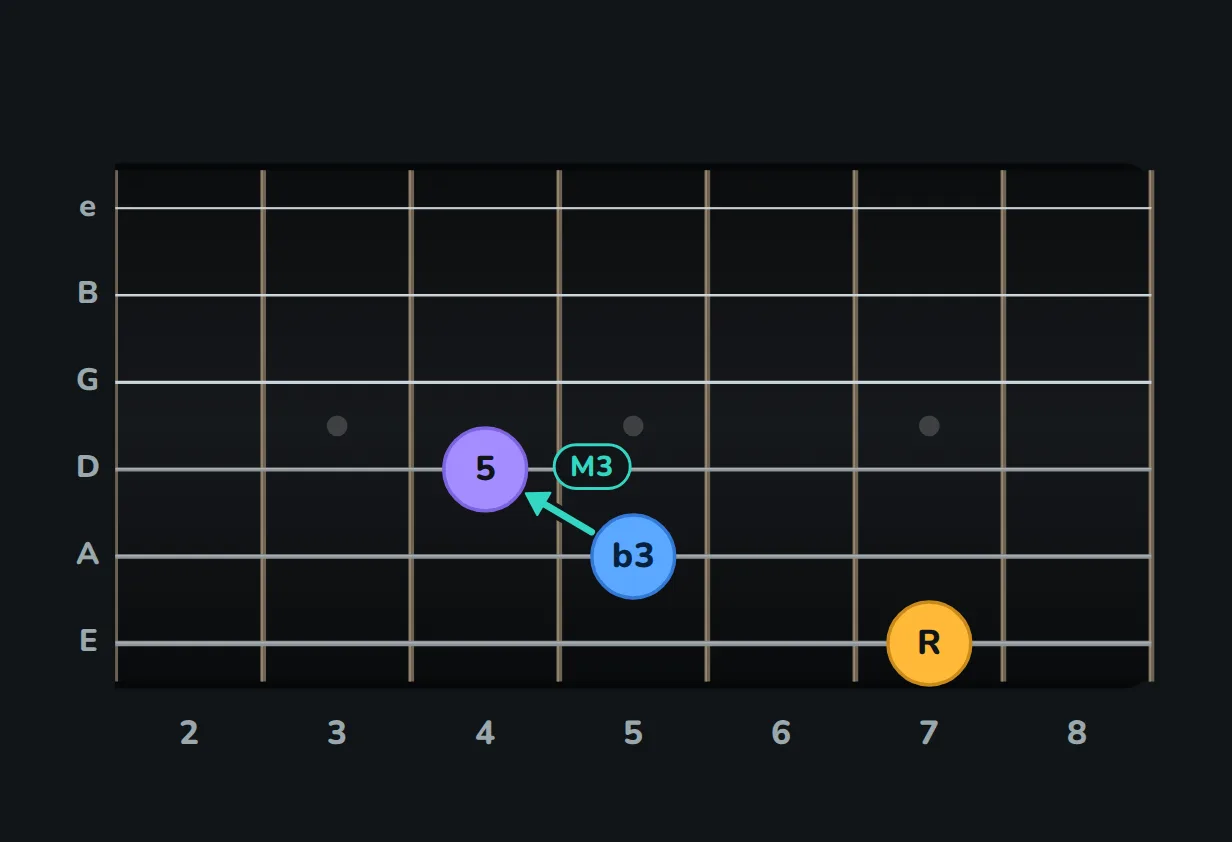
Put one on any chord tone: a major third from the flat three reaches the five
Let’s build the B major chord, which stacks a major third and then a minor third. The major-third shape from the root reveals the three. The minor-third shape on top of the three reveals the five.
Now remember, the minor chord just reverses the order: minor third, then major third. So for the B minor chord, the minor-third shape reveals the flat three, and the major-third shape on top of it still reaches the same five.
Static diagrams are shown below. Enable JavaScript to play this demonstration with guitar sound.
Inspect the final diagram
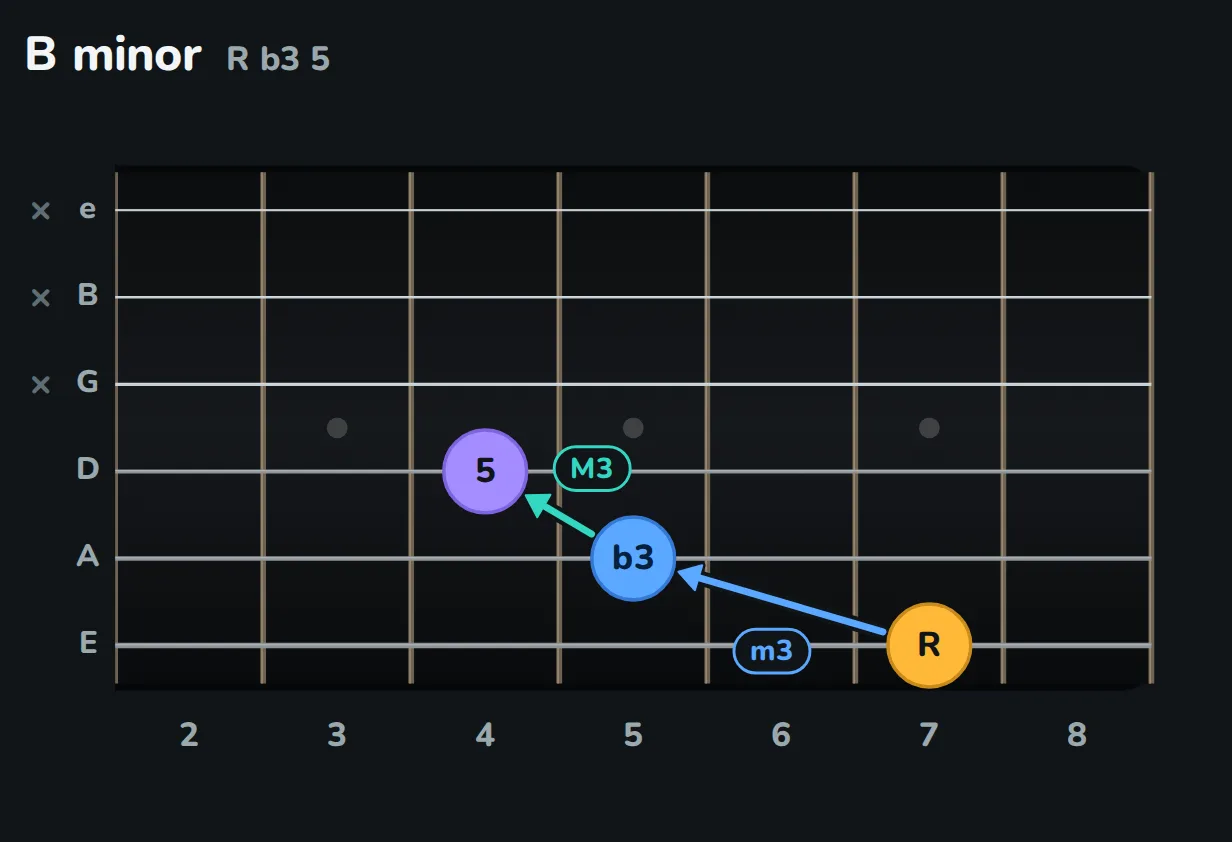
B minor: a minor third, then a major third. The five stays.
Now from the five we can stack a minor third to reach flat seven, which gives us the B minor seven chord.
If we change the flat three to three, it becomes the B seven chord.
And if we change flat seven to seven, it becomes the B major seven chord.
Static diagrams are shown below. Enable JavaScript to play this demonstration with guitar sound.
Inspect the final diagram
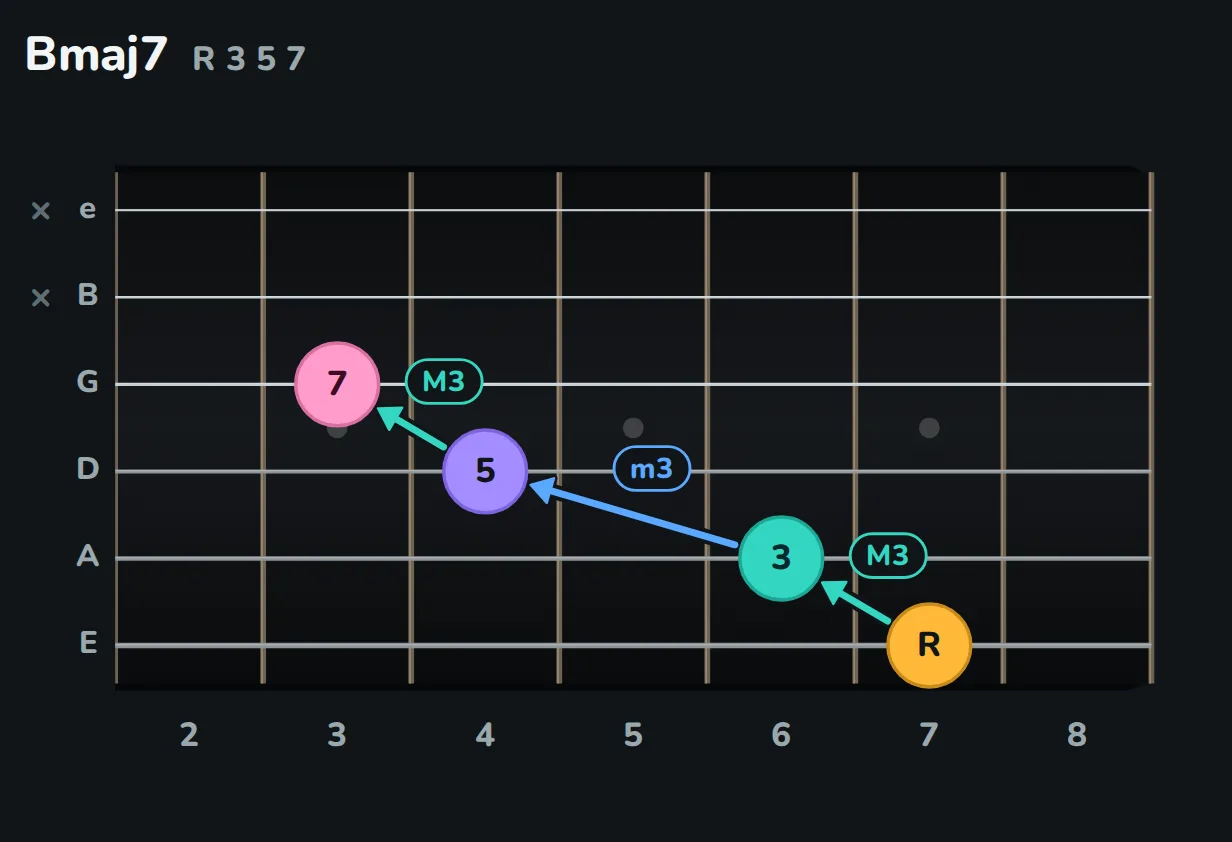
Bmaj7: the flat seven becomes the seven
The G-to-B adjustment
So far the voicings we built make the construction easy to see. We also stayed off the B string on purpose, because if a shape crosses from G to B, there is one small adjustment to make.
Let’s see what happens if we just apply the shapes without making adjustments. Here’s the same A on two different strings. From each one, we apply the major-third shape.
If the shape always works, both should land on the same note. Listen to both:
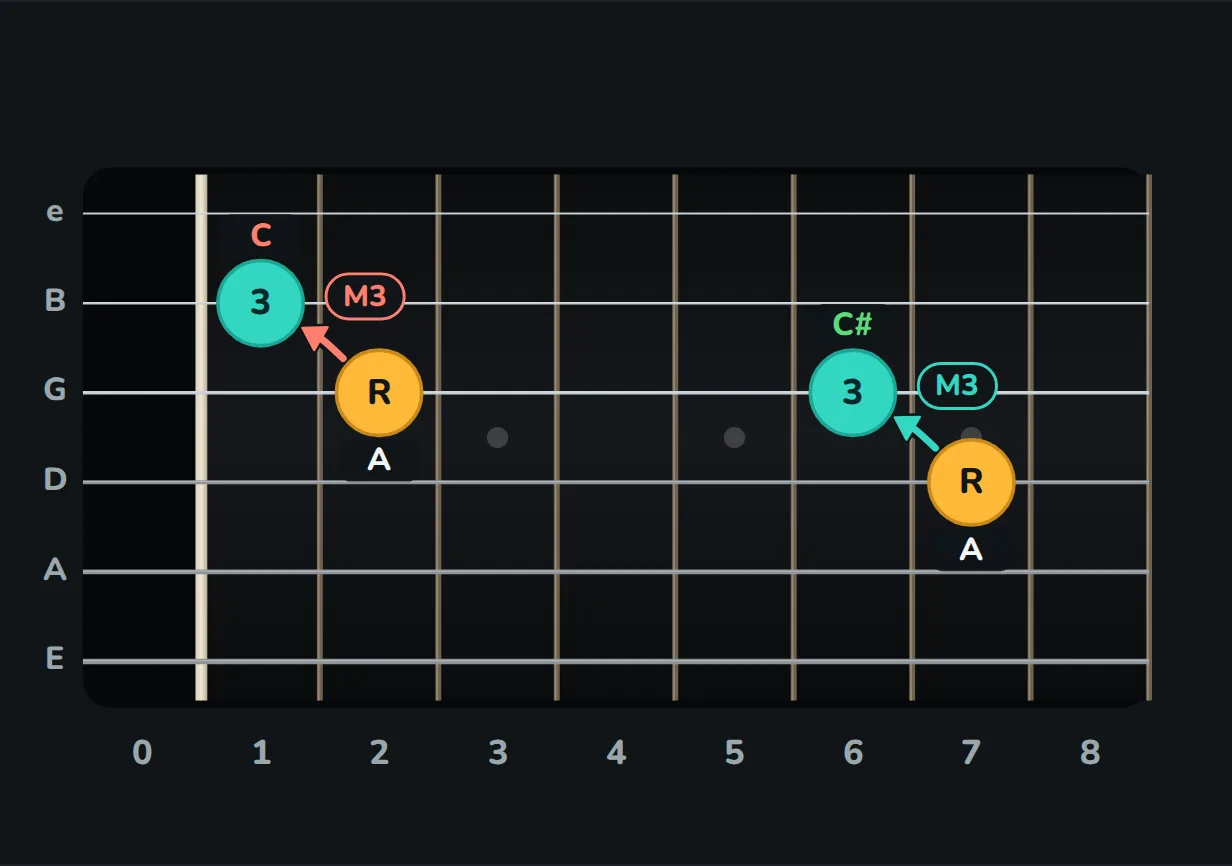
Scroll sideways to inspect every fret.
From the D string the major-third shape reaches C♯. Crossing from G to B it lands one fret short, on C.
Enable JavaScript to hear these notes.
They don’t, right?
That is because the B string is tuned one fret lower than the pattern expects, so every shape that crosses from G to B shifts one fret higher. Our open guitar chord shapes lesson shows the same shift moving whole chords between strings.
Let’s make the adjustment and listen again.
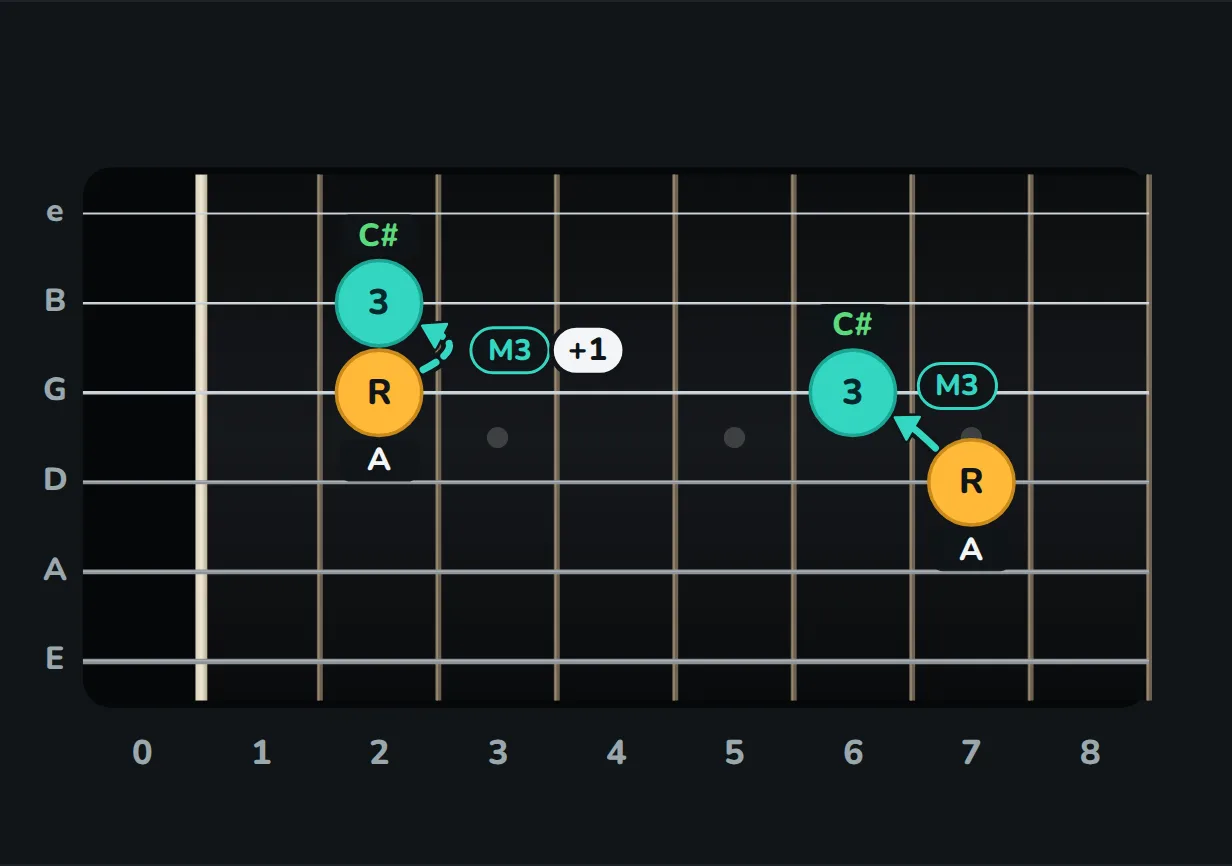
Scroll sideways to inspect every fret.
One fret higher, plus one, and the shape from G lands on C♯ too.
Enable JavaScript to hear these notes.
Now they match.
Build the open E chords
Stacking thirds tells us which tones make up a chord. A guitar voicing can put those chord tones in a different order and repeat some of them.
Let’s apply the shapes to build some common chords.
The power chord: root-to-five and five-to-root
Start with E on the open low E string.
Both third shapes go down a fret or two, and there’s nothing below an open string. So we need our two other shapes.
Remember that major and minor both land on the same five? The root-to-five shape jumps straight there: one string up, two frets higher.
And the five-to-root shape takes the five back to the root: one string up, same fret, an octave higher.
The third shapes reveal the chord tones one step at a time. These root-to-five and five-to-root shapes are shortcuts.
That’s already a chord: the E power chord, written E5. The chord tones are root and five, no third.
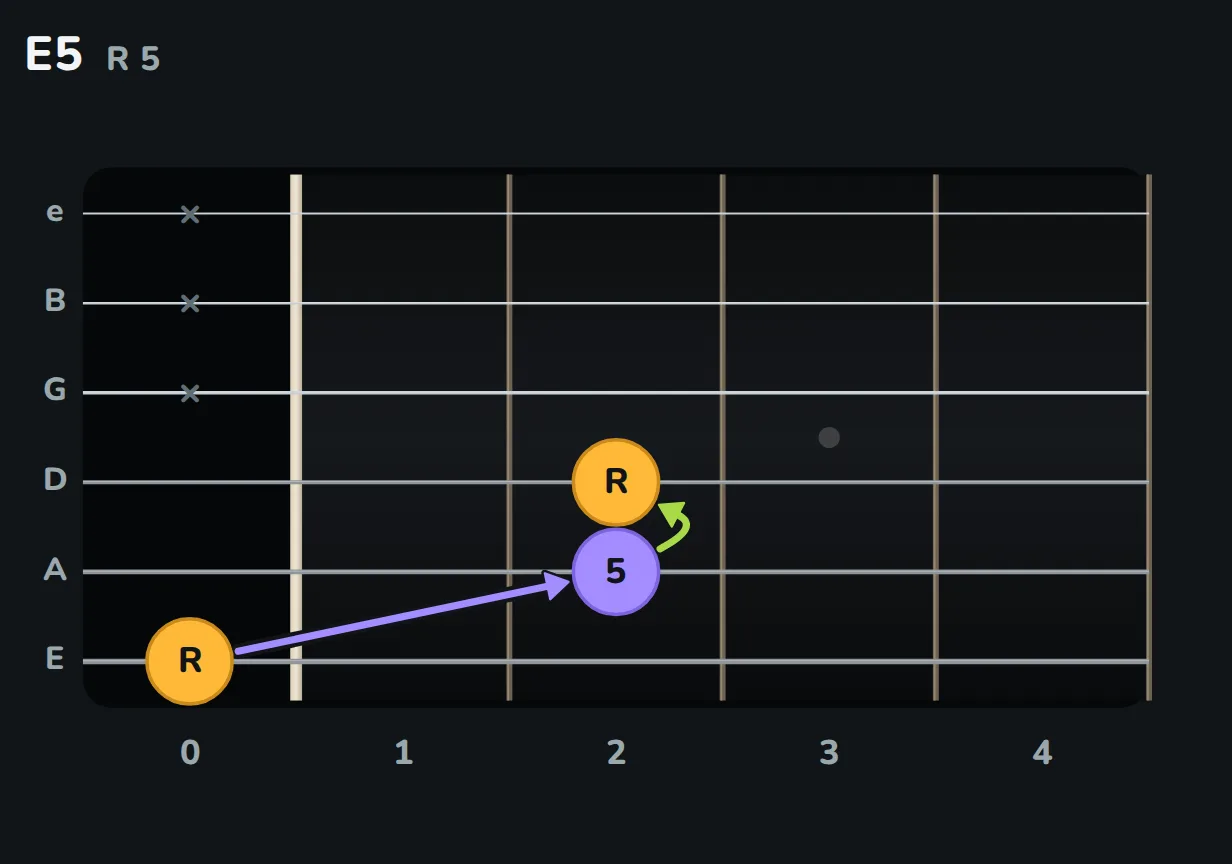
Root to five: one string up, two frets higher. Five to root: one string up, same fret.
Enable JavaScript to hear these notes.
E major and E minor
Let’s continue building E major. From the root an octave up, on the D string, we stack a major third to get to the three.
From the three, a minor third, plus the G-to-B adjustment, gives the five.
And from the five, back to the root again.
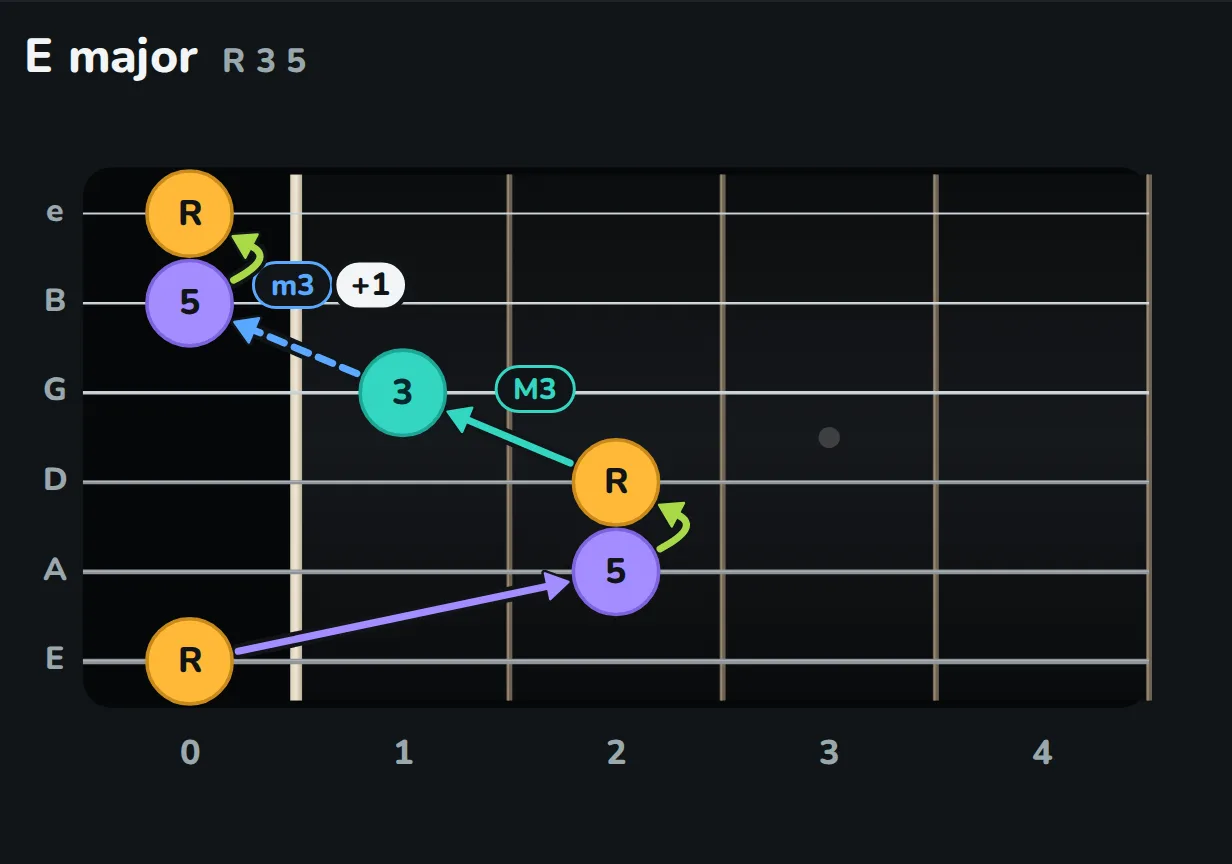
From the root on the D string: a major third, a minor third plus one, then five to root.
Enable JavaScript to hear these notes.
E minor is very similar. The only difference is that instead of a major third first and a minor third second, it reverses: a minor third first and a major third second.
Same start: root-to-five, then five-to-root.
From the root on the D string, a minor third, two frets lower, lands on the open G: the flat three.
Then a major third crosses from G to B, so it moves one fret higher, landing on the open B: the five.
And from the five, the root again.
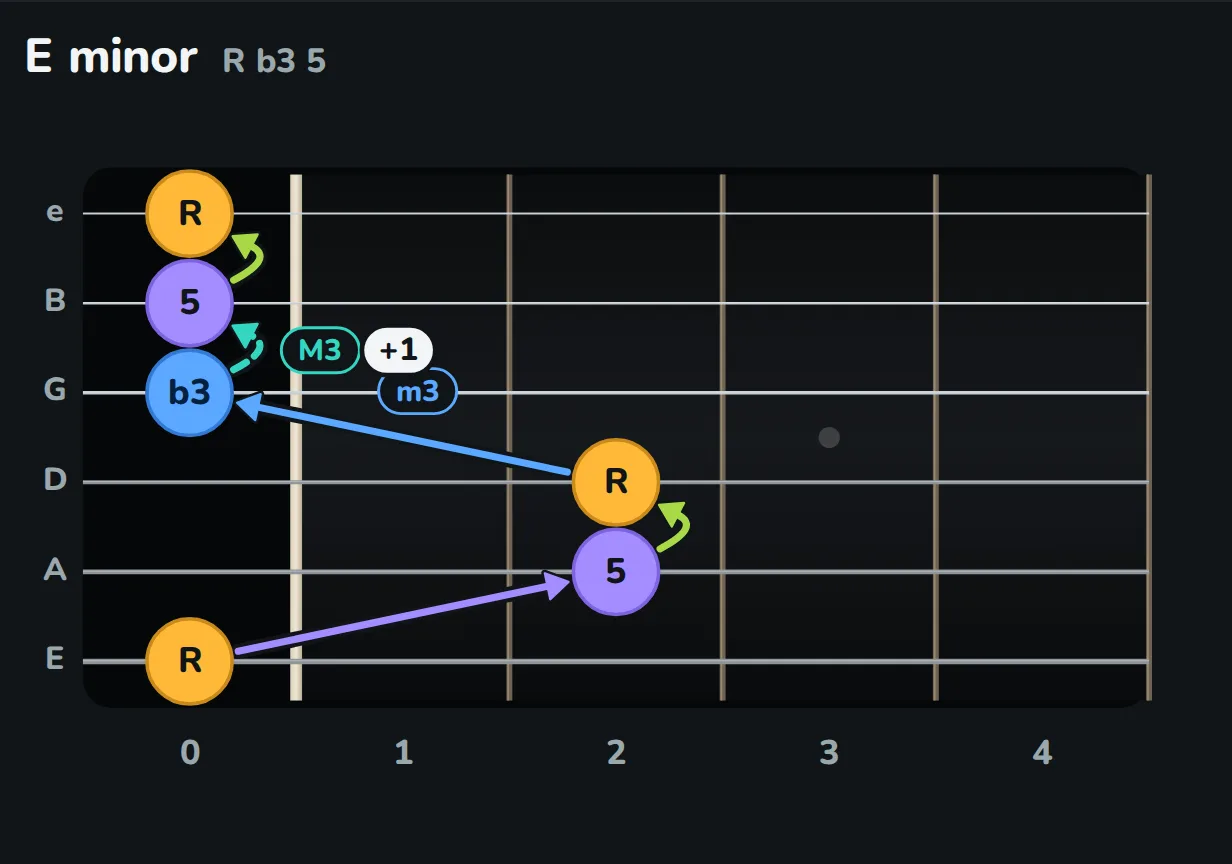
The thirds reverse: a minor third to the open G, then a major third plus one.
Enable JavaScript to hear these notes.
Watch the chords morph into each other just by changing the order of the thirds.
Static diagrams are shown below. Enable JavaScript to play this demonstration with guitar sound.
Inspect the final diagram
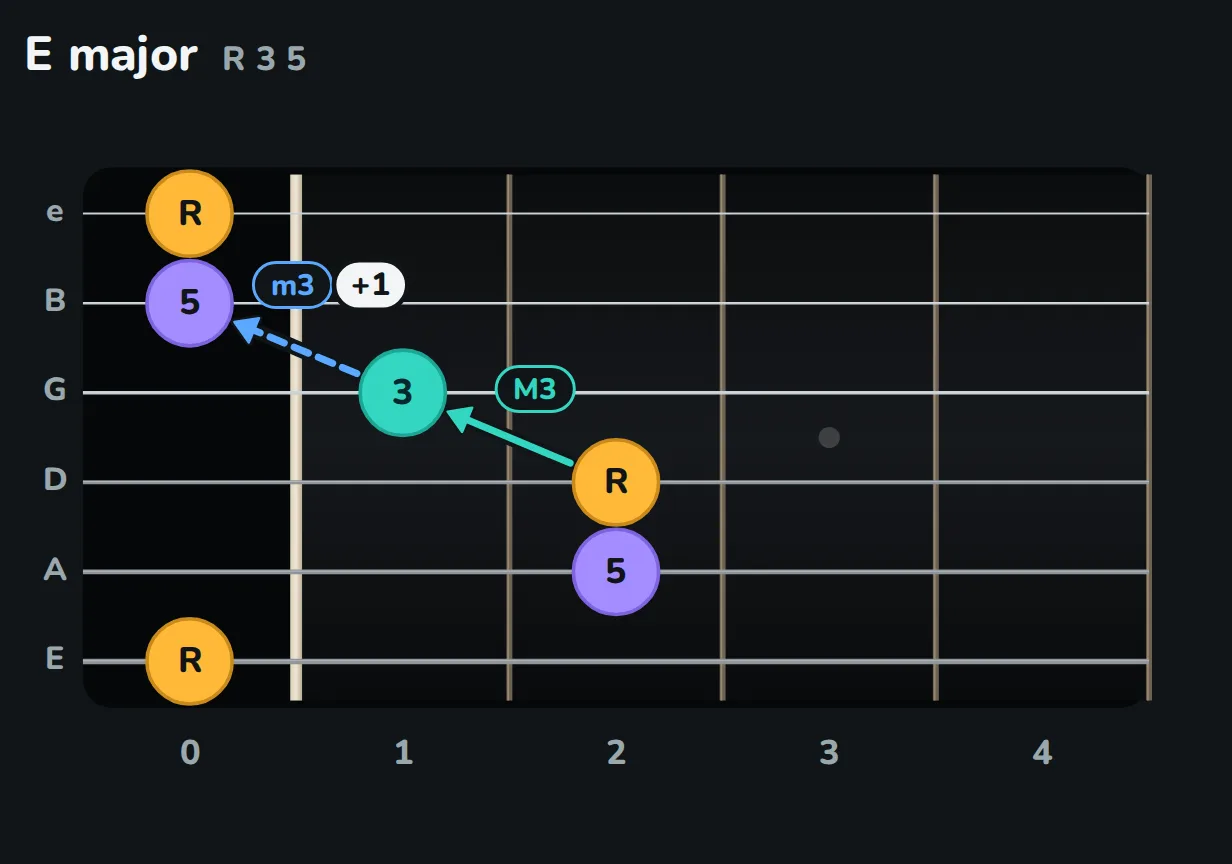
And back to E major
Seventh chords and the imaginary root
Let’s build the E major seven chord now, which is root, three, five and seven.
From the root, the root-to-five shape again, then from the five a major third, one fret lower, lands on the seven.
The seven took the root’s place on the D string. You can imagine the root is still there, one fret higher, and keep stacking from it.
We don’t play this imaginary root. We just use its position to find the chord tones on the remaining strings.
From the imaginary root, the same three, five and root as E major.
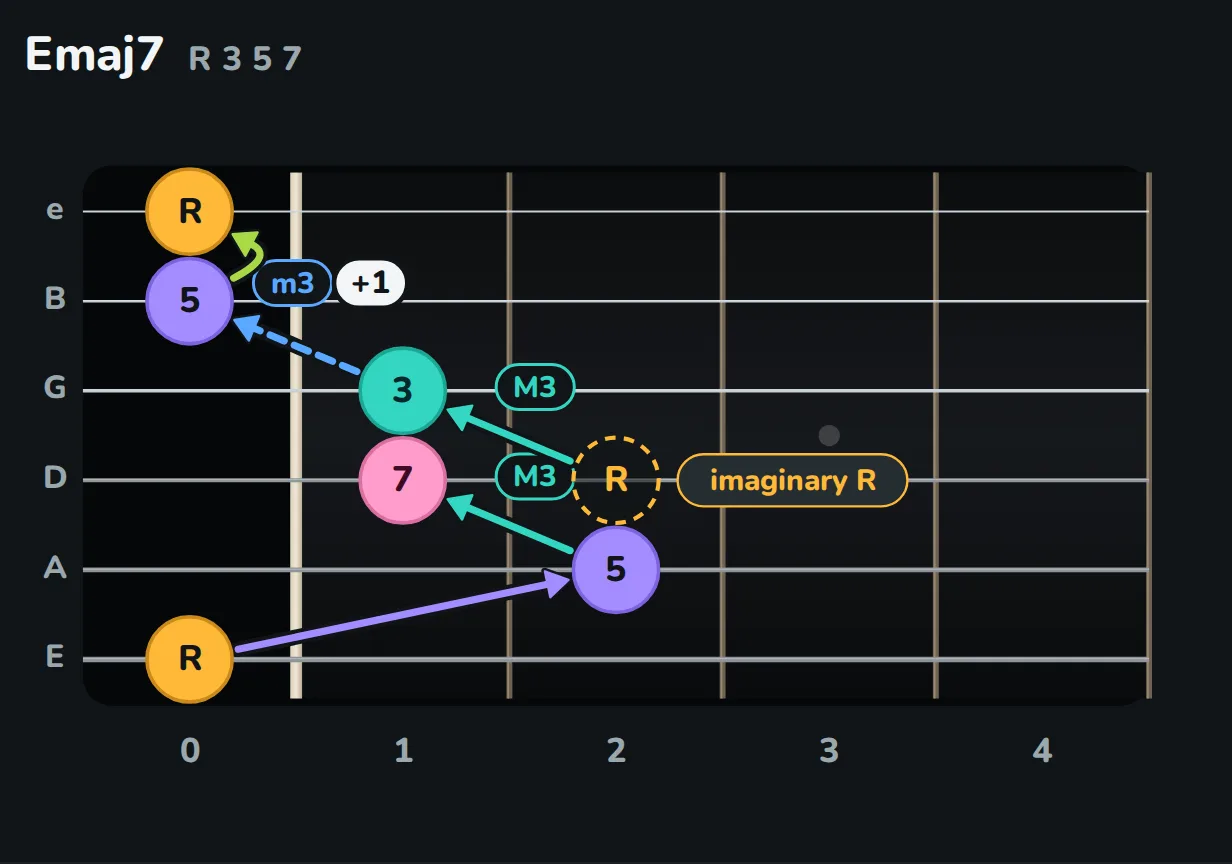
The seven takes the root's place on the D string. Imagine the root one fret higher and keep stacking.
Enable JavaScript to hear these notes.
Now the E seven chord, which is root, three, five and flat seven.
This time, from the five we stack a minor third, two frets lower: the open D, flat seven.
Same trick with the imaginary root, then three, five and root, just like E major.
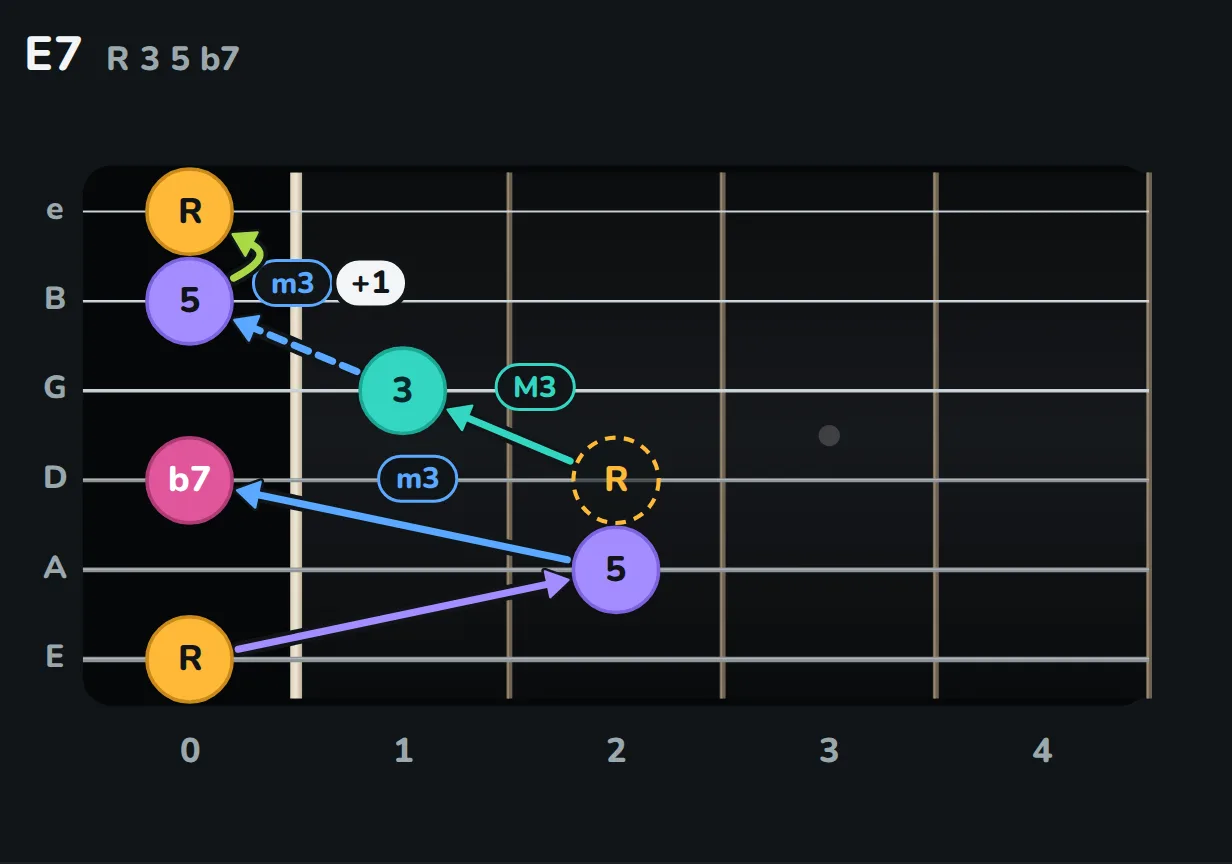
From the five, a minor third, two frets lower, lands on the open D: the flat seven.
Enable JavaScript to hear these notes.
And finally the E minor seven chord, which is root, flat three, five, flat seven.
Flat seven on the open D again, and from the imaginary root a minor third lands on the open G: the flat three.
Then five and root, just like E minor.
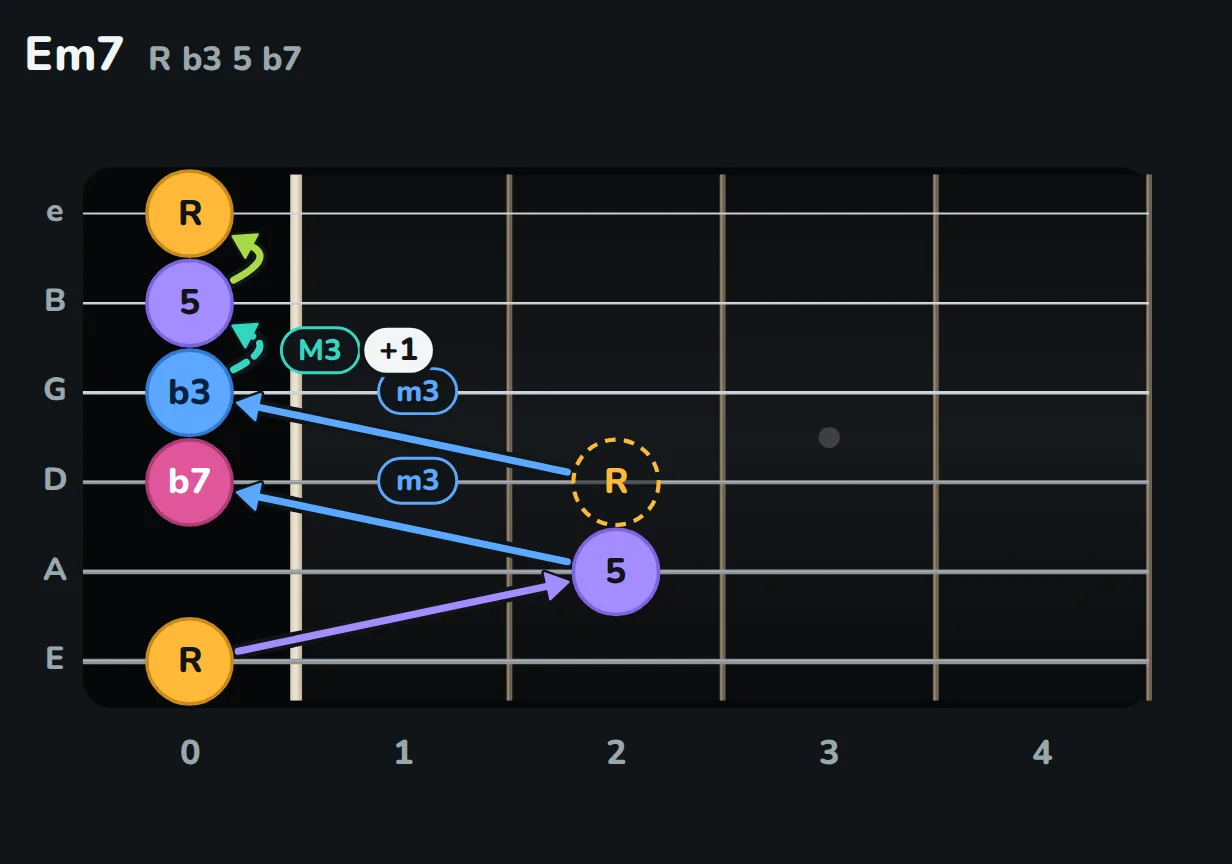
Flat seven on the open D, and a minor third from the imaginary root to the open G.
Enable JavaScript to hear these notes.
Here are all of them, morphing into each other.
Static diagrams are shown below. Enable JavaScript to play this demonstration with guitar sound.
Inspect the final diagram
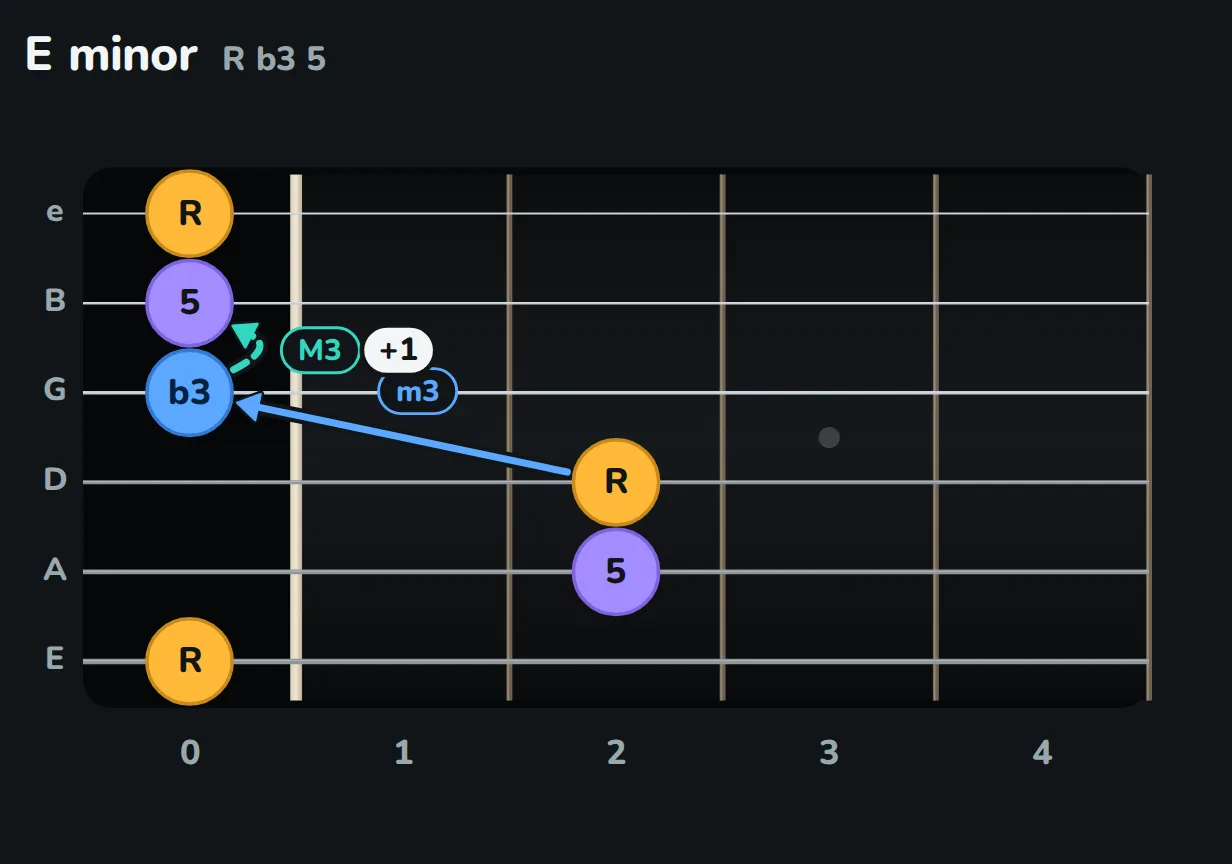
E minor: the flat seven goes back to the root
One more: C major, Cmaj7 and C minor
Let’s do one more, this time C major.
Our root is C, on the A string, third fret.
Unlike E, this root isn’t on an open string, so there’s room below it: we can go straight for the three.
The major-third shape gives us the three. The minor-third shape from there lands on the open G: the five.
From the five, the five-to-root shape finds C again, but it crosses G to B, so one fret higher.
One more major third lands on the open high E: another three. That’s the C chord you already know.
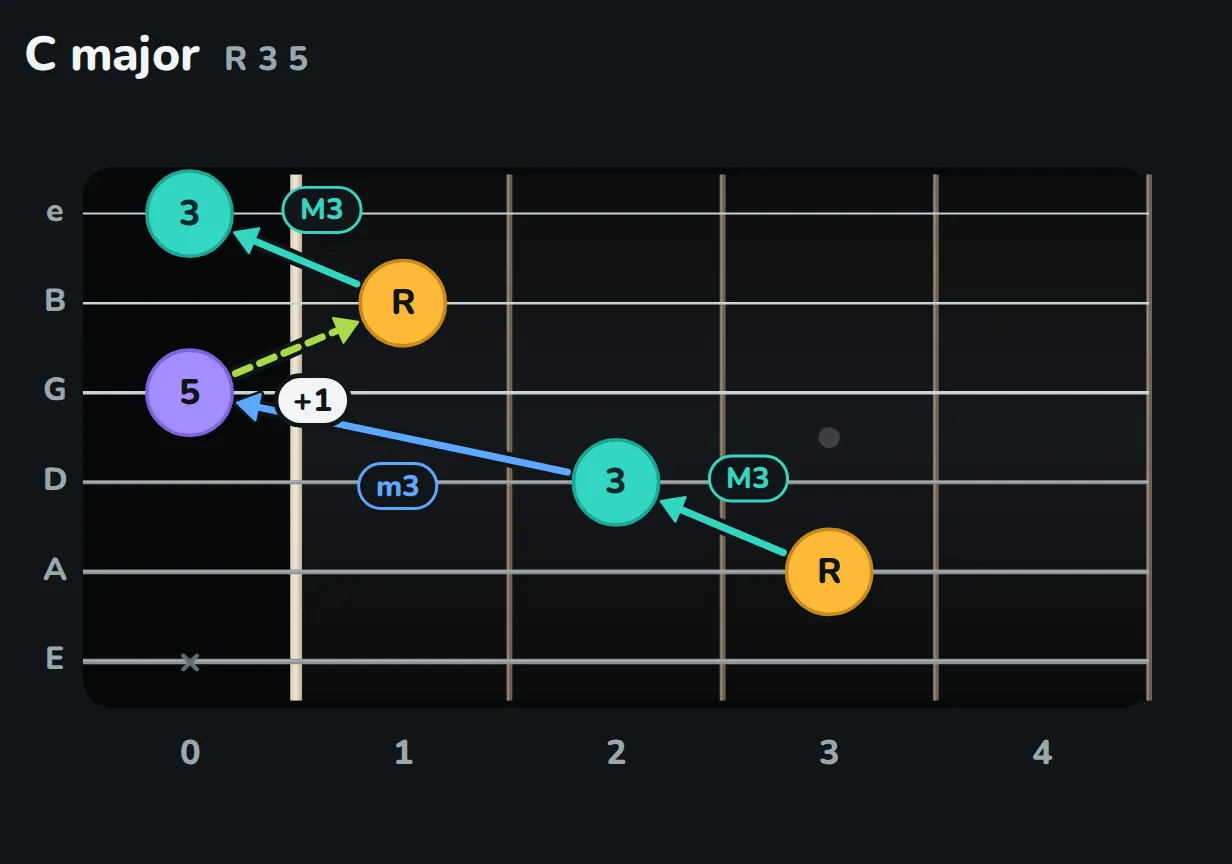
Major third, minor third, five to root plus one, then one more major third.
Enable JavaScript to hear these notes.
Now let’s turn it into a C major seven chord, which stacks one more major third on top of the five.
From the five, the major-third shape crosses G to B, so one fret higher: it lands on the open B, the seven.
The seven takes the root’s place on the B string. Imagine the root is still there, one fret higher.
The open E is still a major third above it: the three.
That’s a C major seven chord.
Static diagrams are shown below. Enable JavaScript to play this demonstration with guitar sound.
Inspect the final diagram
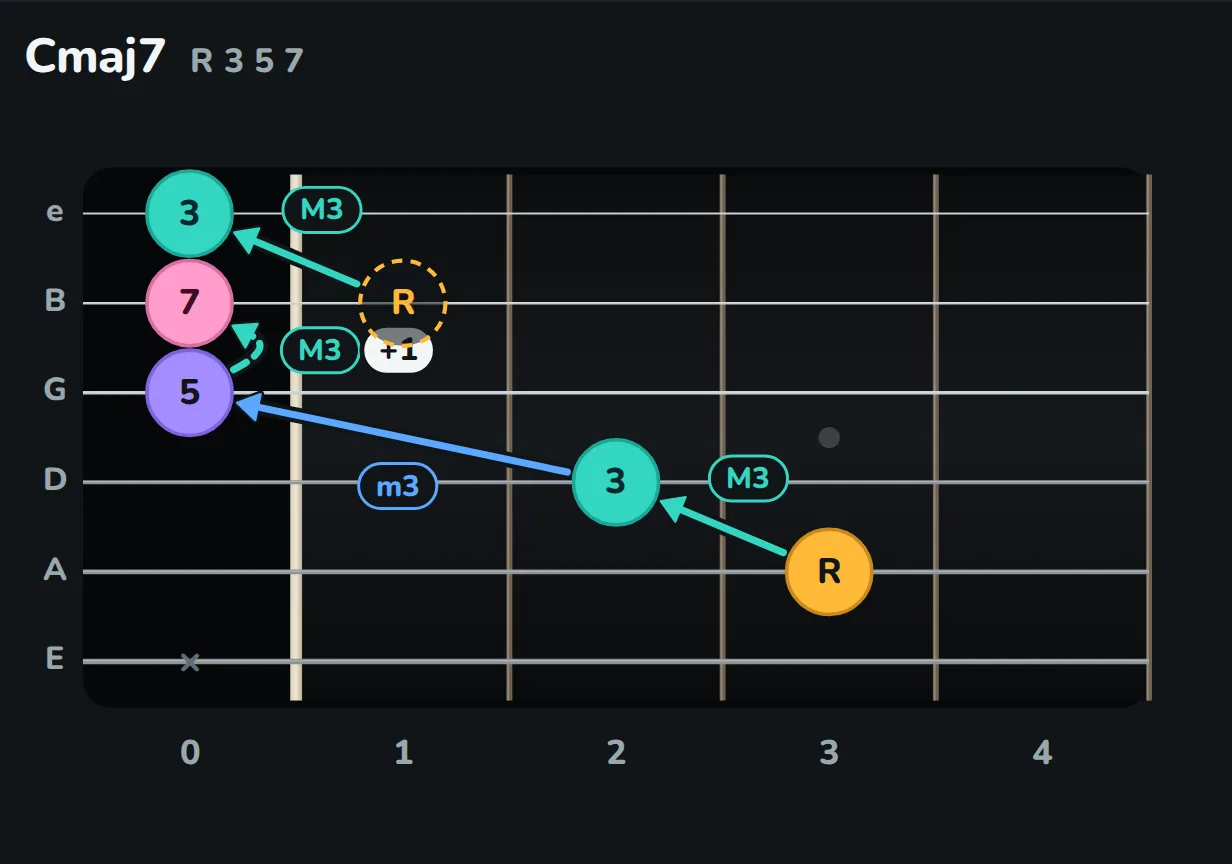
Cmaj7: a major third on the five, plus one, lands on the open B. The root gives way to it.
For C minor, start with a minor third instead: the flat three.
The major-third shape to the five, then the five-to-root shape with its plus one.
The minor-third shape from here would need a fret below the nut, so we use the root-to-five shape instead, two frets higher: C minor.
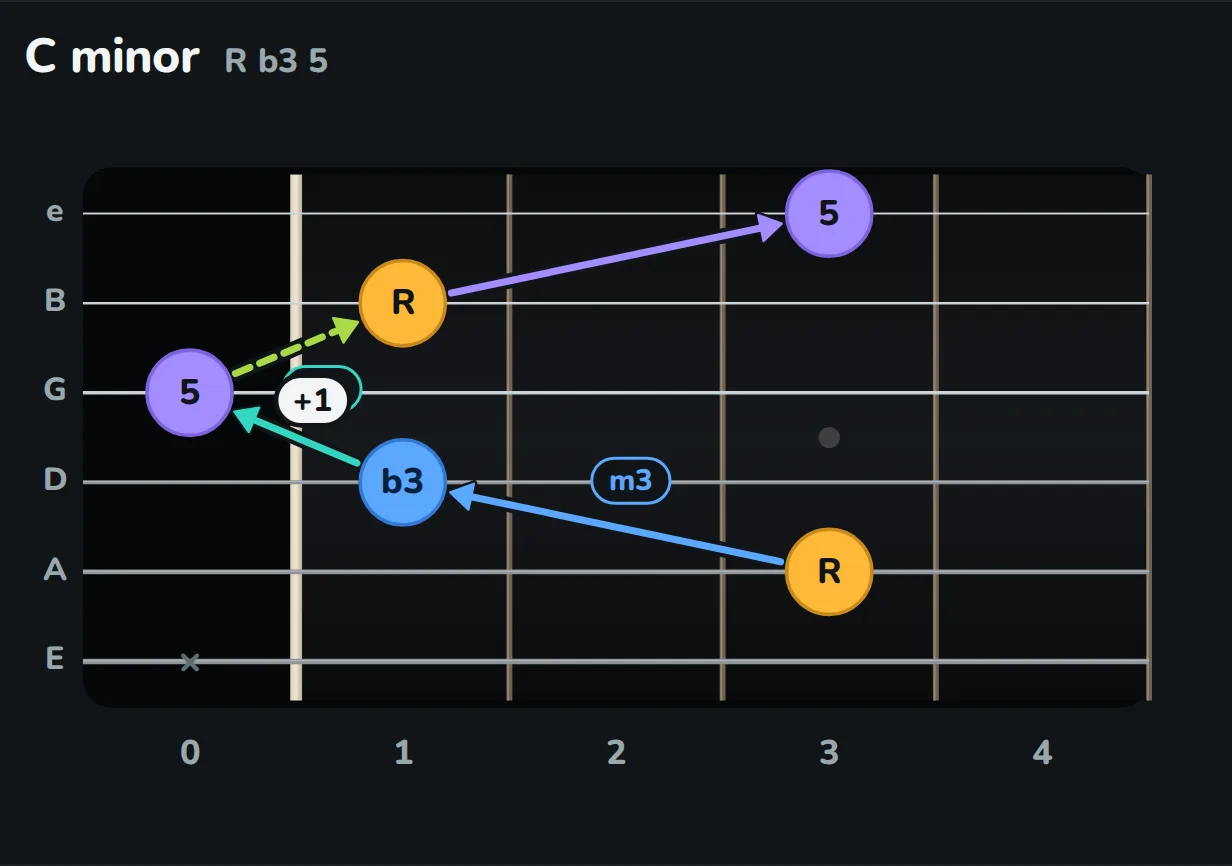
A minor third first, then the major third, five to root plus one, and root to five up the neck.
Enable JavaScript to hear these notes.
The most common C minor is a barre chord, but this one works too, and now you know where every note comes from.
The shapes at a glance
| Shape | From | Where it lands |
|---|---|---|
| Major-third shape | any chord tone | the next string up, one fret lower (four frets on one string) |
| Minor-third shape | any chord tone | the next string up, two frets lower (three frets on one string) |
| Root-to-five shape | the root | the next string up, two frets higher |
| Five-to-root shape | the five | the next string up, same fret, an octave higher |
Whenever a shape crosses from the G string to the B string, it lands one fret higher.
What comes next
Stack one more third and you get ninths, then elevenths and thirteenths.
They’re less common, and walking them on the fretboard takes a few new tricks. That’s a lesson of its own.
If you want to learn more, install FretGenius.
Watch the complete lesson
Download FretGenius
Begin your Note Path with the full guided system, coaching, and progress tracking.
Next step
Free online fretboard note trainer
Turn this guide into action with a quick tool or the full system.